

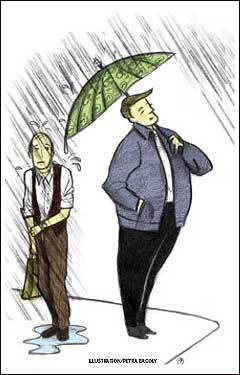

Soak the rest of us
For decades, the American tax burden has been shifting away from the rich. Now, two economists say, it could be at the brink of a historic tipping point.
Three weeks ago, the economists Thomas Piketty and Emmanuel Saez made headlines by announcing that, in 2005, the top 1 percent of American earners -- that year, those making more than $350,000 -- received a larger share of American income than at any time since the roaring '20s.
Over at the US Treasury Department, the top spokesperson replied that, yes, inequality had grown somewhat, but thanks to Bush administration policies, the well-off were paying a greater share of taxes than ever. Administration policies had "made the tax code more progressive, not less."
Is that true? Whose tax burden is the highest may be on more minds than usual this week. And it just so happens that Piketty, an economist at the Paris School of Economics, and Saez, who teaches at the University of California at Berkeley, have published another paper, in the current Journal of Economic Perspectives, that examines how all taxes -- from payroll taxes through income and estate taxes -- affect Americans at each income level, and how tax burdens have changed over the past generation. Their short answer: The rich are paying less than ever.
What's more, Piketty and Saez's data suggest that we're approaching a historic threshold: Should current trends continue -- from higher payroll taxes to the potential impact of the Alternative Minimum Tax on middle-class earners -- the US system could tip from progressive to flat in a matter of years, at least for the top half of earners.
Like the income study, the paper is controversial, but some economists are calling it the most sophisticated historical analysis of the US tax system they've seen. The paper "does a very careful job of putting together 40-odd years of data, which goes well beyond what most people have done," says James Poterba, an MIT economist.
How progressive the tax code ought to be -- whether, and by how much, tax rates should go up as income goes up -- is a question on which economists, not to mention political parties, disagree, the answers shaped by theories about economic efficiency and political morality. But the study offers important context for the coming debates over who should foot the bill to strengthen Social Security and how to revise the Alternative Minimum Tax. Created in 1969 to target millionaires with creative accountants, the AMT can now hit people making as little as $50,000. In 2007 it is projected to affect fully one in five Massachusetts residents.
. . .
Because there have been so few historical analyses -- and none that present such a fine-grained view of the top 5 percent of earners, few people grasp just how much progressivity has been eliminated in the US tax code, Piketty and Saez contend.
"In a way, the US has been playing yo-yo with the rich," says Piketty. Once it soaked them, even compared with high-tax Europe -- Americans in the 1960s and early '70s showed a greater appetite for taxing the rich than even French socialists ever dared -- and now it treats them with unique gentleness.
Most analyses of progressivity look at the income, payroll, estate, and corporate taxes in isolation, but Piketty and Saez have assembled all of these into one picture. In 1960, adding together all taxes, Americans from the 95th to the 99th percentile paid 24 percent of their earnings in taxes. From there, though, rates soared: those in the top 0.01 percent paid fully 71 percent.
Today, from the 95th percentile on up, the total tax burden in America rises gently from 28 percent to 35 percent. For the top 1 percent, the authors write, "the current federal tax system is relatively close to a flat-tax rate" -- a historically remarkable development.
The article also clarifies how the once-radically progressive American system did its work. In 1960, strikingly high nominal income-tax rates for the wealthiest tax payers were offset by far more deductions than exist today, making the actual income-tax rate at the top not that much higher than today's. Back then, though, the corporate tax and estate taxes pinched those with the biggest incomes much, much harder. (For a complicated host of reasons, corporations report far less taxable profits than they did in 1960, so the corporate tax has faded in importance. And Republicans have been chipping away at the estate tax for years.)
This part of the story is familiar: At the top, overall rates came down steadily through the 1970s, took a further dip during the Reagan Revolution, were bumped up by Clinton, then reached historic lows in 2004.
Less noticed is that, further down the income ladder, rising payroll taxes -- which finance Social Security and disability-insurance programs -- have, over the long term, more than offset cuts in income-tax rates. This, too, has narrowed the gap between the middle-class and the highest earners. From the 40th percentile to the 60th, taxes have risen only a bit since 1960: from 15.9 percent to 16.1 percent. But from the 60th percentile to the 80th, they've climbed from 16.7 percent to 20.5 percent.
Several aspects of the study are open to challenge. Who actually ends up bearing the burden of the corporate tax, for example, is a longstanding subject of debate among economists. And economists who stress the progressivity of the American system dispute including the payroll tax, because its future benefits (Social Security checks) also disproportionately accrue to the non-rich.
Alan Reynolds, a senior fellow at the Cato Institute, a libertarian think tank, adds another objection, pointing out than more and more middle-class Americans are socking money away in tax-free instruments like Roth IRAs. Their tax rates, therefore, appear much higher in the Piketty-Saez study than in the real world.
Piketty concedes the point, but counters that the wealthy have even more ways of shielding their income, so the study may actually overstate progressivity. The authors also say it is "improper and misleading" to point out that the top 1 percent, as a group, contributes more tax revenues than ever -- without clarifying that this is solely because they receive a larger share of income than ever.
Only in the bottom third of income is progressivity alive and well. Piketty and Saez don't even offer data for the poorest 20 percent of Americans, because many of them earn no market income and are supported, for example, by Social Security or disability insurance. The next group, taxpayers from the 20th to the 40th percentile, have seen their overall tax rates drop since 1960: from 13.9 percent to 9.4 percent.
But from there on up the income ladder, long -term trends and current pressures are against progressivity. Solidifying the financial footing of Social Security could well lead to higher payroll taxes: Kent Conrad, the Democratic chairman of the Senate Budget Committee, has said that option needs to at least be considered. And the wealth level at which the Alternative Minimum Tax kicks in does not take inflation into account, so many middle-class earners could soon face unpleasant tax increases -- and budget projections assume those increases will occur. Both parties are maneuvering over how to handle that regressive time bomb.
But the authors doubt that the days of progressivity are done. One lesson of the study is just how quickly attitudes toward taxing the wealthy can shift. The antitax revolt against an earlier era's soak-the-rich mentality has gone about as far as it can go, they suspect -- and the emergence of a class of super-rich, as federal budget woes multiply, could create new enthusiasm for progressive taxes.
"I think there will be a backlash," Piketty says.
Christopher Shea's column appears biweekly in Ideas. E-mail criticalfaculties@verizon.net. 